
“YOGA IS THE CULTIVATION OF A PARTICULAR FORM OF UNDERSTANDING: IT IS AN INVESTIGATION INTO OUR INNER MOST BEING TO DEVELOP NOTHING LESS THAN ITS CONSTANT RADIANT MANIFESTATION.”
YOGA OPENS THE BODY, MIND & HEART.
Regular yoga practice rooted in mindful movement and meditation benefits the body, mind, and heart by creating openness at every level of consciousness. This expansiveness allows us to connect with the whole of experience - to embrace our full humanity - our full aliveness. That is the essence of “practicing yoga.” The openness created through yoga practice strengthens, stretches, and destresses the body; soothes, relaxes, and decompresses the mind; and expands the loving capacity of the heart. The therapeutic and self-revelatory benefits of of yoga are numerous and profound.
BODY MOVER
Mindful movement builds muscle and bone, increases strength and flexibility, and improves endurance and balance. It also provides essential nutrients for joint mobility by squeezing and soaking cartilage and connective tissue. Mindful movement helps us “use it, so we don’t lose it,” keeping us active and vital. Mindful movement aids the healing of many diseases like diabetes, arthritis, asthma, hypertension, and cancer. Mindful movement also prevents cartilage and joint breakdown and osteoporosis.
IMMUNITY BOOSTER
Mindful movement and meditation boost immunity by eliminating toxins, lowering stress hormone production, and reducing inflammation. Mindful movement and meditation are associated with increased lymph drainage that helps fight infection and dispose of toxic cellular waste; lower cortisol levels, the primary stress hormone; and reduced inflammation response. Reduced chronic inflammation is associated with lower risk of many diseases including diabetes, heart disease, and cancer.
PAIN REDUCER
Mindful movement and meditation reduce pain by relieving muscle tension (especially pain related to the lower back) and improving overall neurological function through stimulation of the vagus nerve. Mindful movement and meditation can relieve lower back pain, reduce migraine intensity and frequency, and lessen the need for prescription pain reducers.
CARDIOVASCULAR IMPROVER
Mindful movement and meditation improve cardiovascular health and blood circulation. Mindful movement and meditation are associated with reduced body mass index measurement, cholesterol, heart rate, and blood pressure. Mindful movement and meditation can lower the risk of heart disease.
RESPIRATORY STRENGTHENER
Intentional breathing combined with mindful movement and meditation strengthens respiratory health by optimizing breathing patterns and increasing vital capacity (a measure of the maximum amount of air that can be expelled from the lungs). Nose breathing increases nitric oxide for vasodilatory and relaxing effects; optimizes oxygen and carbon dioxide homeostasis levels; protects lungs and airways by warming and humidifying inhaled air; ensures moisture in mouth cavity for oral health; and filters air. Intentional breathing combined with mindful movement and meditation can improve symptoms of asthma.
DIGESTIVE HELPER
Mindful movement and meditation help digestive health by stimulating the internal organs and promoting a relaxation response. Mindful movement is like internal massage for the digestive tract, stimulating internal organs for improved digestion and elimination. Engaging the parasympathetic nervous system through yin-type yoga and meditation promotes relaxation response. Mindful movement and meditation can relieve constipation, abdominal bloating, and digestive discomfort.
SLEEP AIDER
Mindful movement and meditation promote quality sleep and the feeling of being energized upon waking. Engaging the parasympathetic nervous system through yin-type yoga and meditation promotes relaxation response to aid the sleep process. Mindful movement can help work the body so that it naturally seeks rest. Mindful movement and meditation can lower the amount of sleep disturbances.
MIND SOOTHER
Mindful movement and meditation soothe, relax, and decompress the mind, which improves learning, memory, and decision-making. Yogi’s have bigger brain parts! Larger amygdala and cingulate cortex influence learning and memory. Larger prefrontal cortex and brain networks are essential in planning, decision-making, and multitasking. Larger hippocampus helps memory. Mindful movement and meditation can counter brain structure deficits associated with dementia and Alzheimer’s Disease.
MOOD ENHANCER
Mindful movement and meditation enhance mood which can lead to a greater sense of emotional well-being. Mindful movement and meditation are associated with increased levels of the brain chemical gamma-aminobutyric (GABA) which tends to be lower in people with anxiety and mood disorders. Mindful movement and meditation can reduce depression, alleviate postpartum disorder, relieve anxiety, and serve as an antidote to stress.
BELONGING BUILDER
When practiced in community, mindful movement and meditation build a sense of belonging. Mindful movement and meditation are related to improved function of the vagus nerve, a key factor in stress resilience and feelings of social connection. Synchronized movements and presence is known to foster feelings of interconnectedness. Mindful movement and meditation can alleviates loneliness.
INSIGHT CATALYZER
Mindful movement and meditation catalyze insight by fostering a relaxed yet alert state of being, leading to epiphany and creativity. Mindful movement and meditation are known to aide neurogenesis and neuroplasticity related to “idea genius” and to increases gamma waves and right and left brain integration for dynamic cerebral activity. Mindful movement and meditation can break the cycle of “stuckness” and replaces recurrent, ineffective approaches with innovative ideas.
HEART OPENER
Mindful movement and meditation open the heart by creating space to feel emotions, allowing us to feel into the whole of life and to feel most alive. Mindful movement and meditation counter face-paced, production-oriented values and promote an intimacy and connectedness with ourselves and others. Mindful movement and meditation can reduce automaton and robotic ways of being and the impulse to numb out through distraction and addiction.

MODERN SCIENCE CONTINUES TO AFFIRM THE MANY HEALTH BENEFITS OF YOGA KNOWN SINCE ANTIQUITY.
Modern science continues to affirm the physical and mental health benefits of yoga for people of all ages as well as the the therapeutic benefits of yoga for people experiencing disease, recovering from illness, and living with a chronic conditions.
WHAT ARE THE HEALTH BENEFITS OF YOGA i MEDICAL NEWS TODAY
YOGA: WHAT YOU NEED TO KNOW I NATIONAL INSTITUTE OF HEALTH
NEUROSCIENCE REVEALS THE SECRET OF MEDITATION’S BENEFITS I SCIENTIFIC AMERICAN
MEDITATION & MINDFULNESS: WHAT YOU NEED TO KNOW I NATIONAL INSTITUTE OF HEALTH
EIGHT PERENNIAL PRACTICES DISTINGUISH YOGA FROM OTHER WISDOM TRADITIONS.
A posture-centered concept of yoga is a modern and misinformed idea about what yoga really is and does. Venerating movement practice cuts into yoga’s totality and potential so severely that it can, and often does, reinforce egoic conditioning and a sense of separateness - the opposite of what holistic yoga practice actually is and does. With the rise of the fitness industry the 1980’s and 1990’s, posture fundamentalism started dominating mainstream yoga practice, particularly in United States - with emphasis on idolized alignment, perfected sequencing, and all variations and manifestations body-based pretentiousness. This kind of posture zealotry and body-based obsessiveness - and the ego-driven power play that goes along with it - created a blindness to yoga’s inherent bigness.
It’s true that practicing asana can feel like an embodied prayer. Mindful movement through asana practice can create openings in our body-minds that support the arising of a unitive experience and help us transcend the illusory notion of separateness. However, yoga is so much more than postural practice. Thankfully, at this particular point in yoga’s evolution, we are collectively moving away from understanding yoga as only physical postures and a moving toward holistic integration of the perennial practices.
Yoga is all the perennial practices. All the perennial practices are one Yoga.
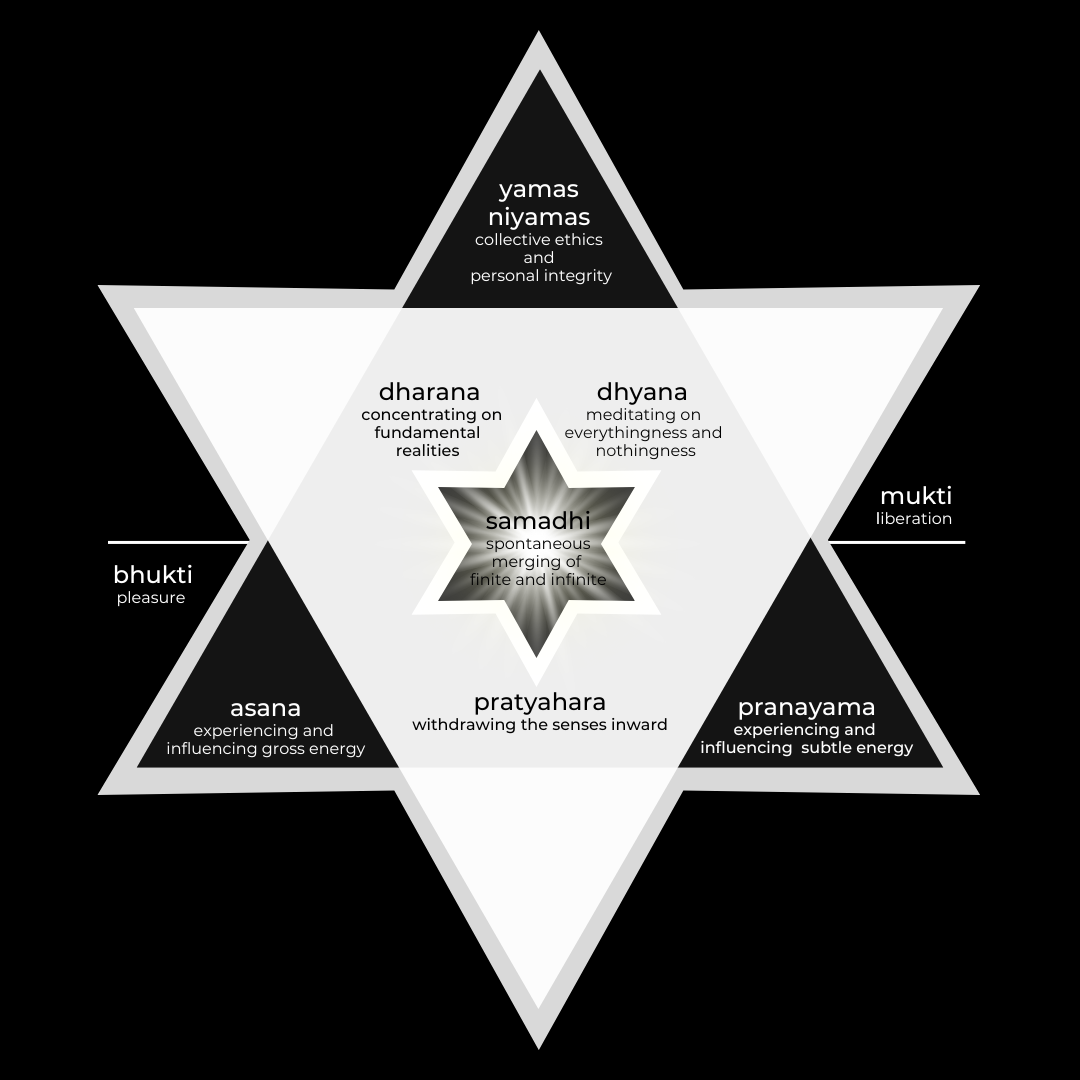
The eight perennial practices that have collectively distinguished yoga from other wisdom traditions for the last few thousand years are:
yamas
observing collective ethics
niyamas
observing personal integrity
asana
experiencing and influencing gross energy
pranayama
experiencing and influencing subtle energy
pratyahara
withdrawing the senses inward
dharana
concentrating on fundamental realities
dhyana
meditating on every-thingness and no-thingness
samadhi
spontaneous merging of finite and infinite
All these practices invite us to move out of our conditioned, habitual body-mind cycles and protection-seeking ego patterns and move into a clear and loving recognition of “what is.” A “what is” that includes increasing sensitivity to not only our physical, mental, and emotional experience, but also to the indivisible interconnectedness of everyone and everything. These practices help us realize the inherent sacredness in all.
Taken together, these practices create a progressive path, each naturally flowing from the previous practice and incrementally emphasizing more subtle awareness of what is. Observing collective and personal ethics through the yamas and niyamas sensitizes us to the whole of life and its fundamental mutuality, without which the fruits of the other practices cannot be fully realized. Asana practice attunes us to gross sensations of our physical body and prepares us for more nuanced energetic awareness of pranayama practice. Pranayama practice hones our ability to experience and influence subtle energy which readies us for more refined awareness of even subtler energy experiencing as we withdrawal our senses inward in pratyahara practice.
Multi-form practice of the yamas, niyamas, asana, pranayama, and pratyahara grows our receptiveness to the sublimity of concentration in dharana and etherealness of meditation in dhyana. Our increased ability to repose in the subtlest states of concentration and meditation opens us to the most subtle and immersive experience of all - samadhi.
While these practices can sequentially unfold, they also develop simultaneously and overlap each other. Each practice nurtures the others. As an interconnected web of influence they are each an integral composite part of the whole of yoga. Engagement with multiple aspects simultaneously increases the potential for development in all the perennial practices and a radical loosening of our identification with our body-mind selves.
Yoga is samadhi-centric. The seven other perennial practices of yoga revolve around samadhi and hold the potential to move us toward the samadhi center where we experience ourselves and all of life as a dynamic continuum of consciousness beyond the distinction of subject and object. They help to create favorable conditions for samadhi to spontaneously arise. The samadhi core is where consciousness experiences itself in an ever-changing field of possibility uncaged by the body-mind.
The perennial practices surrounding samadhi group themselves in a couple interesting configurations. One pattern they create are concentric layers where yamas, niyamas, asana, and pranayama form an outer layer of practices that explore the most dense aspects of energy, while pratyahara, dharana, and dhyana form an inner layer of practice that explore the most subtle aspects of energy. In this nested circular structure, the outer ring of practices develop greater awareness through the most physical levels of experience – our relationship with our surrounding environment and the physicality of our bodies, while the inner ring of practices develop greater awareness through the most subtle levels of experience – the thoughts and feelings of our minds and hearts.
Another way the perennial practices organize themselves around samadhi is through a top-bottom split of practices. In this pattern, asana, pranayama, and pratyahara are grouped in the bottom-half as bhukti-centered practices that foster sensory pleasure. Yamas, niyamas, dharana, and dhyana are grouped in top-half as mukti-centered practices that prompt awakened insight and liberations from suffering.
It can be helpful to notice our personal practice patterns – where we place the greatest and least amount of our attention and where we might find better balance.
“YOGA IS A WAY OF MOVING INTO STILLNESS IN ORDER TO EXPERIENCE THE TRUTH OF WHO YOU ARE. THE PRACTICE OF YOGA IS THE PRACTICE OF INNER LISTENING, IN POSES AND MEDITATIONS, AS WELL AS ALL DAY LONG. IT’S A MATTER OF LISTENING INWARDLY FOR GUIDANCE ALL THE TIME, AND THEN DARING ENOUGH AND TRUSTING ENOUGH TO DO AS YOU ARE PROMPTED TO DO.”